Streamlined three-tier loyalty program where every member enjoys the same high-quality rewards, with benefits escalating at each tier.
Simple yet effective, this program stands as the best deal for Eloking's boosting services, ensuring maximum value and satisfaction for all our users.
Cashback on all Eloking boosts (3%, 5%, 7%)
Discounts for all Eloking boosts (5%, 10%, 15%)
Discount for a friend 🤗
Free daily lootbox spin with industry-leading rewards
Member exclusive season and event offers
How to Fix FPS in Path of Exile 2
j
Anthony King
Gamer
02 Aug 2026
Updated On
What should you change first when Path of Exile 2 starts griefing your FPS? Nothing - until you build a same-scene F1 baseline and prove whether the drop follows graphics load, the renderer, the network line, or one specific encounter.
Randomly nuking every setting gives you an uglier game and no clean answer. Change one variable, replay the same trouble spot, and keep only the changes that move the numbers.
Build a Same-Scene F1 Baseline Before Touching Settings
Pick the zone, map, or encounter where performance consistently falls apart. Stand in the same location, use the same skills or repeat the same combat sequence, and press F1. Record the displayed FPS and ping before changing anything. That is your same-scene F1 baseline. Without it, a smoother-feeling run could just be an easier pack or a quieter moment.
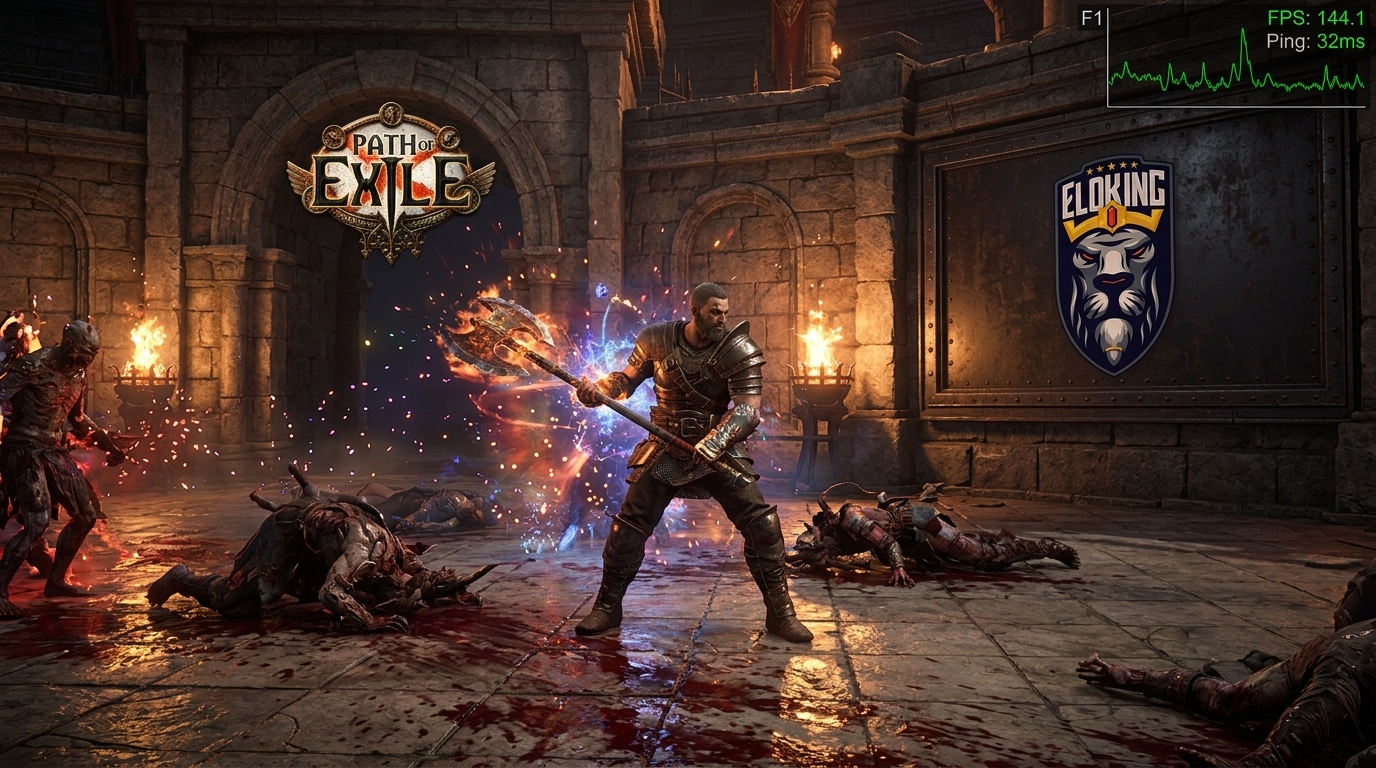
The F1 overlay also displays a network graph in the top-right. The light-green line tracks network latency, and spikes indicate a connection issue. If the ugly hitch lands with a green-line spike, test a manually selected nearby gateway from the login screen's Options menu instead of leaving Gateway on Auto. That targets ping. It is not an FPS tweak.
If FPS drops while that green line stays calm, you have ruled out one visible correlation - not diagnosed the PC. The overlay does not identify thermals, storage pressure, shader compilation, power throttling, or a frame cap by itself. Keep the baseline and move to rendering tests.
Test the 4K Ultra-to-Low Jump and Lighting Separately
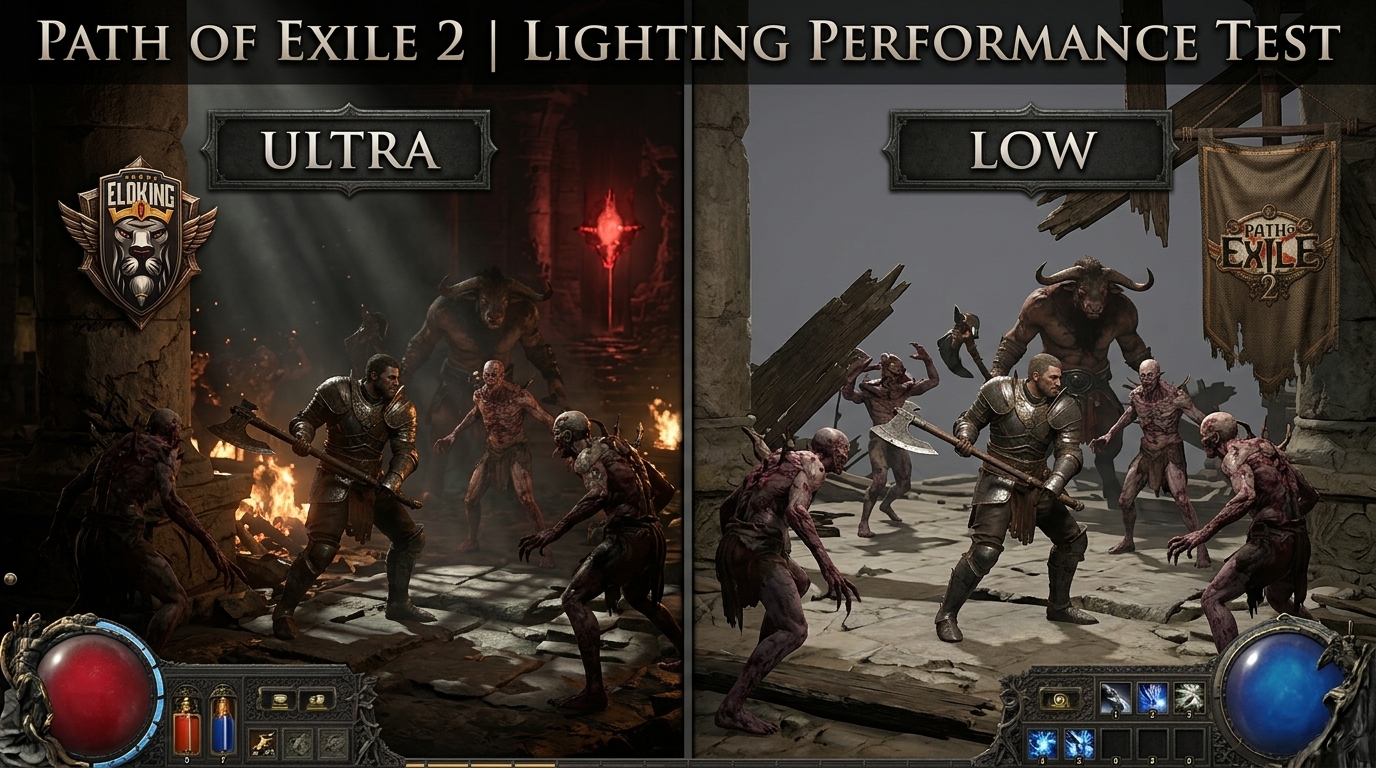
Start with the broadest rendering-load check. One benchmark used an i7-14700K, RTX 4090 FE, and two 16 GB DDR5 modules rated for 6000 MT/s at CL30. It reported 167 FPS at 4K "Ultra," 189 FPS at 1440p, and 225 FPS at 1080p. In the benchmark's 4K results, moving from "Ultra" to "Low" raised average FPS from 167 to 223. The source created those labels from all-high and all-low settings, and it does not identify the exact build or scene. Treat that increase as evidence that rendering load scaled on the test rig, not as your promised gain.
For a targeted test, change Lighting from Shadows + GI to Shadows only. This change was reported to raise FPS by about 17% at 1080p during fast combat. Replay your baseline scene. If the gain is real on your setup, keep it. If not, put the visual quality back.
Keep Engine Multithreading enabled to distribute AI and physics work across CPU cores, although the evidence here gives no measured FPS delta. At 1440p or 4K, trial DLSS, FSR, or XeSS in Quality mode when your test indicates a GPU-bound workload. Again, no universal uplift is documented here.
Compare DX12 and Vulkan Instead of Picking a Team
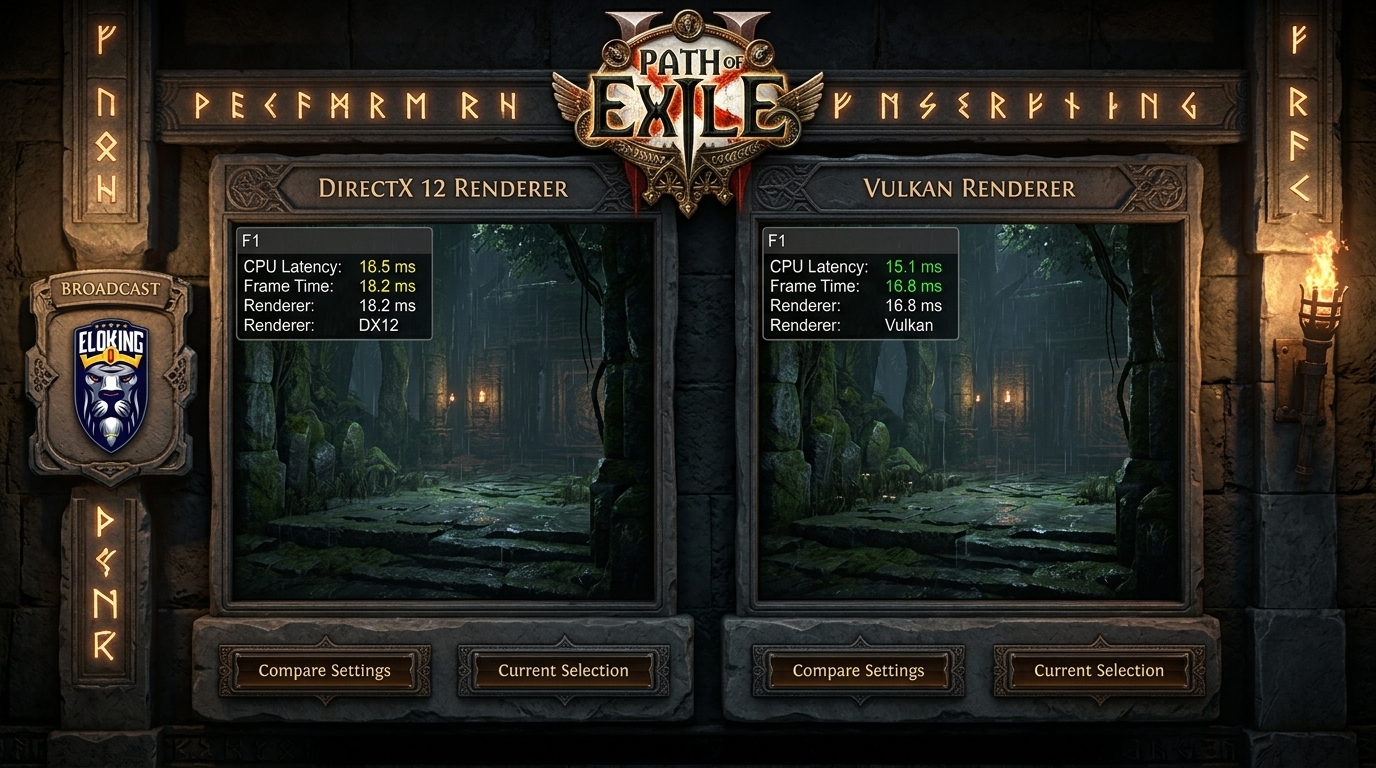
Renderer takes age badly. An April 5, 2025 Dawn of the Hunt guide recommends Vulkan over DX12, while a GamesFuze guide updated June 1, 2026 says DX12 is generally more stable and smoother on high-end PCs and Vulkan may perform better on lower-end or AMD systems. That disagreement is exactly why your own same-scene result wins.
Decision
DX12
Vulkan
What current guidance suggests
June 1, 2026 guidance leans DX12 for high-end PCs.
The same guidance leans Vulkan for lower-end or AMD systems.
What to compare
Check the reported CPU latency in the F1 overlay.
Use the identical scene and compare the same reading.
What to keep
Keep DX12 if it shows lower CPU latency in the repeated test.
Keep Vulkan if it shows lower CPU latency in the repeated test.
If Vulkan blocks launch
Open Documents\My Games\Path of Exile 2\poe2_production_Config.ini and set renderer_type to DirectX12.
Do not keep forcing Vulkan when the game will not launch.
Repair One Layer at a Time When FPS Still Stays Low
Verify: In Steam, right-click Path of Exile 2, select Properties, open Installed Files, and click Verify integrity of game files.
Confirm: On a laptop with integrated and dedicated graphics, select the dedicated GPU for Path of Exile 2.
Update: Install the applicable NVIDIA, AMD, or Intel GPU-driver update, then replay the baseline scene.
Update: Apply Windows updates, then test again without stacking another intervention.
Update: Install current DirectX and Visual C++ Redistributable components as recommended by the April 2025 troubleshooting guide.
Record: Write down the before-and-after FPS for every repair so a placebo fix does not make the cut.
Do not reinstall first. These documented repair steps provide an escalation path, not guaranteed FPS improvements. The clean rule is brutal but useful: if a change does not improve the same scene, it did not fix your measured problem.
Press F1 in-game to open the performance overlay. It shows FPS, latency, and a network graph in the top-right corner, with a light green line for network latency and spikes that point to connection issues.
There is no universal winner. An April 2025 Dawn of the Hunt guide recommended Vulkan over DX12, while a June 2026 patch 0.5 guide described DX12 as generally smoother on high-end PCs and Vulkan as potentially better on lower-end or AMD systems. Test both yourself: run the same scene with the F1 overlay on each renderer and keep the one with lower reported CPU latency and steadier frames.
What’s next?
Now that you have learned something new - it’s time you start playing and get better. Choose a game to purchase Eloking Boost for.
Purchase ELO Boost at Eloking
and start playing at the rank you deserve!



















 Quality

