Streamlined three-tier loyalty program where every member enjoys the same high-quality rewards, with benefits escalating at each tier.
Simple yet effective, this program stands as the best deal for Eloking's boosting services, ensuring maximum value and satisfaction for all our users.
Cashback on all Eloking boosts (3%, 5%, 7%)
Discounts for all Eloking boosts (5%, 10%, 15%)
Discount for a friend 🤗
Free daily lootbox spin with industry-leading rewards
Member exclusive season and event offers
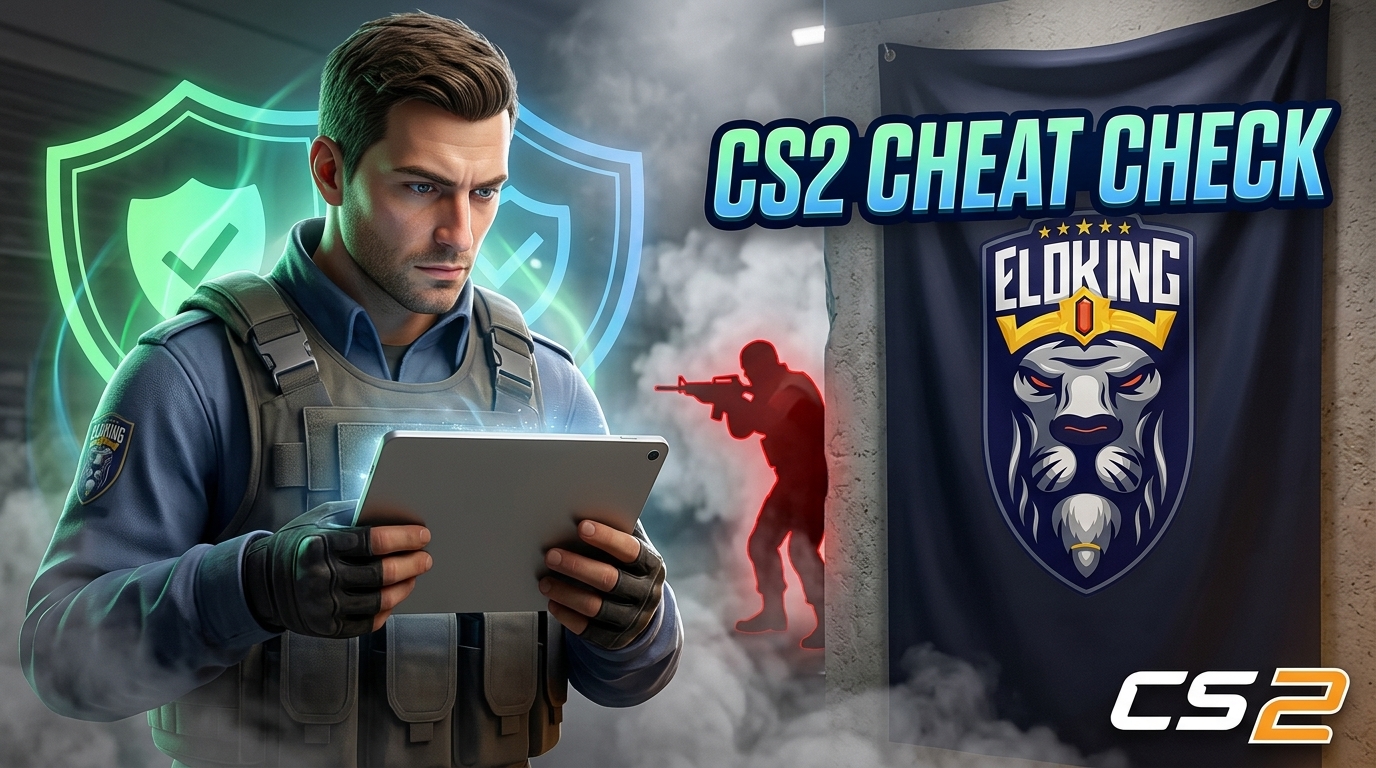
How to Detect Cheaters in CS2 and What to Do When You Run Into Them
h
Malik Hamza Rashid
Gamer
12 Jul 2026
Updated On
Listen to this post
TL;DR: A single suspicious round isn't proof of cheating in CS2; only repeated patterns justify a report. Use the scoreboard quickly, choose the closest cheat category, and include concrete details like round, time, map, and evidence. Clean reports help, while tilt, griefing, and vague accusations only waste time.
One impossible round is all it takes to set off the panic: a player pre-aims the exact off-angle, swings the right corner again, and suddenly the whole lobby is ready to scream cheat. But CS2 doesn't hand out justice from a single highlight, and that's where most players get fooled. The real question is whether the weird play keeps repeating, because only then does the scoreboard report flow, the evidence, and the anti-cheat layers start to matter.
That's the trap this guide untangles: how to tell a lucky read from Wall Hacking or Aim Hacking, when to report fast, and what details actually make a complaint worth reviewing. If the match smells bad, you need to know exactly what to do before tilt turns your report into noise.
CS2 scoreboard report flow is not one magic ban button
CS2 anti-cheat is layered, not singular. VAC handles the long game, VAC Live can kick in during a match, Trust Factor shapes the lobbies you get, and review systems sit behind the scenes. That matters because you should stop expecting one instant miracle and start thinking in layers. One system catches known cheat behavior. Another can interrupt the game sooner. Another influences who you even meet in queue.
VAC has been protecting Counter-Strike since 2002, and the core idea is simple: it scans for known cheat signatures and unauthorized memory modifications. Steam Support describes VAC as an automated system built to detect cheats on a player's computer, and it treats third-party modifications that give an advantage as cheats or hacks. VAC bans are permanent, apply to your entire Steam account for the game, and are non-negotiable.
VAC Live is the newer piece of the puzzle. Instead of only caring about the ban later, it is described as a way to detect and remove cheaters mid-match. Trust Factor is the quiet one, but it matters just as much for the average player. So yes, the stack is real. But no, it does not mean every suspicious flick is proof. That's why the response protocol matters.
Struggling to win? Bad teammates?
Purchase a game with one of our PRO players.
One game
Average wait time <30 minutes
$4.00
$3.32 per game
Two games
Average wait time <30 minutes
$8.00
$3.00 per game
Three games
Average wait time <30 minutes
$12.00
$2.50 per game
Don't call wall hax on one miracle shot
The biggest mistake players make is turning one absurd round into a courtroom verdict. That's how you end up calling every strong aimer a cheater. Bad read. Tilted read. Useless read.
Look for patterns that survive multiple rounds. Does the player pre-aim the same off-angle every time, even when there's no information? Do they keep swinging the exact right spot after fake pressure? Are they locking onto heads with a level of consistency that holds up round after round, not just in one highlight clip? That's the difference between a lucky read, a cracked player, and someone who actually deserves a report. One impossible kill can be noise. A repeated pattern is signal.
Stay strict with yourself here. If you start labeling every top-frag as Wall Hacking or Aim Hacking, your reports lose weight and your own head gets cooked. The goal is not to become a detective with a rage problem. The goal is to notice what keeps happening after the hype wears off. If the suspicion survives the next few rounds, act. If it doesn't, save the ego and move on.
When the lobby smells bad, use the scoreboard report flow fast
Open the scoreboard with TAB as soon as the pattern feels real.
Right-click the player from the scoreboard mini-profile and hit Report.
Pick the best category you can justify: Wall Hacking, Aim Hacking, or Other Hacking.
Keep the match clean by muting chat if needed and refusing to argue in voice or text.
Track the moment mentally so you remember the round, map side, or exact play that made the suspicion clear.
Finish the game on purpose instead of griefing your own team because one guy is being a clown.
That last step matters more than people want to admit. Feeding the troll gives the cheater extra value. You want the opposite. Keep steady, and make the match as boring for the cheater as you can while still playing to win. If the game is already cooked, your job is damage control, not emotional warfare.
What makes a report worth reviewing?
A weak report says "cheater." A strong report says, "Round 7 on Mirage, T side, he pre-fired the exact bench angle three times in a row, and the clip starts at 1:42." One of those is venting. The other is usable.
SteamReport's reporting guide says concrete evidence helps reports move faster. That means round numbers, timestamps, clip links, or demo markers. It also says a strong CS2 report should include the player's SteamID64 or full profile URL, the match context, and a clear description of the cheating behavior. That is the kind of detail that makes a report look like a report, not a tantrum.
You do not need to write a novel. You need enough structure that a reviewer can understand what happened without guessing. If you have a clip, note the exact time. If the issue happened on a specific map and side, write that down. If the behavior repeats, mention that too. Better reports don't guarantee instant justice, but they give the system something real to work with. Vague rage gets ignored. Specific context has a chance.
Trust Factor can keep the worst lobbies away before the match even starts
Trust Factor is the part players underrate because it does not give them a flashy pop-up. But it changes your baseline lobby quality, and that matters more than people think. If your account looks healthy, you're more likely to get cleaner matches. If it looks sketchy, you're more likely to get thrown into the swamp with cheaters and griefers.
The inputs Valve and the guide point to are not mysterious. Account age. Hours played. Steam level. Game library size. Phone number verification. Reports received. Commendations received. VAC or game ban history. That list tells you exactly why "just make a new account" is not a magic fix. The system is reading signals, not vibes.
So the practical move is simple: keep your account clean, verify your phone, avoid trash behavior, and understand that your matchmaking pool is part of the problem too. You cannot control every lobby. You can control whether your account looks like the kind of account the system trusts.
After the match, treat the cheater like a disruption, not a diagnosis
What should you do after the match? Cool down. That's it. Not revenge-queueing. Not rerunning the demo until 3 a.m. Not convincing yourself the whole game is cooked because one guy was scripting his way through your evening.
If you still have evidence to save, grab the round notes, clip time, or demo marker now while it's fresh. Then stop. Drink water. Walk for two minutes. Queue later. The point is to keep one dirty match from turning into three tilted ones. Most players lose more MMR to tilt than to the cheater itself.
Long term, keep the perspective straight: VAC bans are permanent and non-negotiable. Steam Support says they are not something Support removes. If a ban was issued incorrectly, it gets removed automatically. That's the part people forget when they start spiraling. Your one match is not the whole system. The system is slower than your rage, but it does keep working.
The clean takeaway is simple: don't become the second problem. Report well, cool off fast, and queue like someone who wants to win the next game instead of reliving the last one.
Save the round details while they are still fresh: map, side, round number, and the exact behavior that set off the alarm. If you have a clip or demo marker, keep that too. A report with partial but specific evidence is still far better than a blank accusation.
Yes, but keep the labels separate. Cheating reports should point to repeated suspicious aim, awareness, or pre-aim patterns, while griefing is a different problem entirely. Mixing every bad act into one angry report makes the complaint look sloppy and weak.
No. A skilled player can land one absurd read and still be completely legitimate. What matters is whether the behavior repeats across rounds in a way that would be hard to explain as luck or normal game sense.
Short is fine if it is precise. Include the round, map, side, and the specific action that looked impossible, such as repeated pre-fires on the same angle or locked-on headshots over multiple rounds. Specific context is what makes the report usable.
Submit the report anyway if you saw a repeated pattern. A clip helps, but round numbers, timestamps, and a clear description of the behavior still give reviewers something concrete to work with. The worst option is saying nothing and then rage-typing in chat.
What’s next?
Now that you have learned something new about Counter-Strike - it’s time you start playing and get better at the game. We can help!
Purchase Eloking CS2 Boost right now
and start playing at the rank you deserve!



















 Quality
