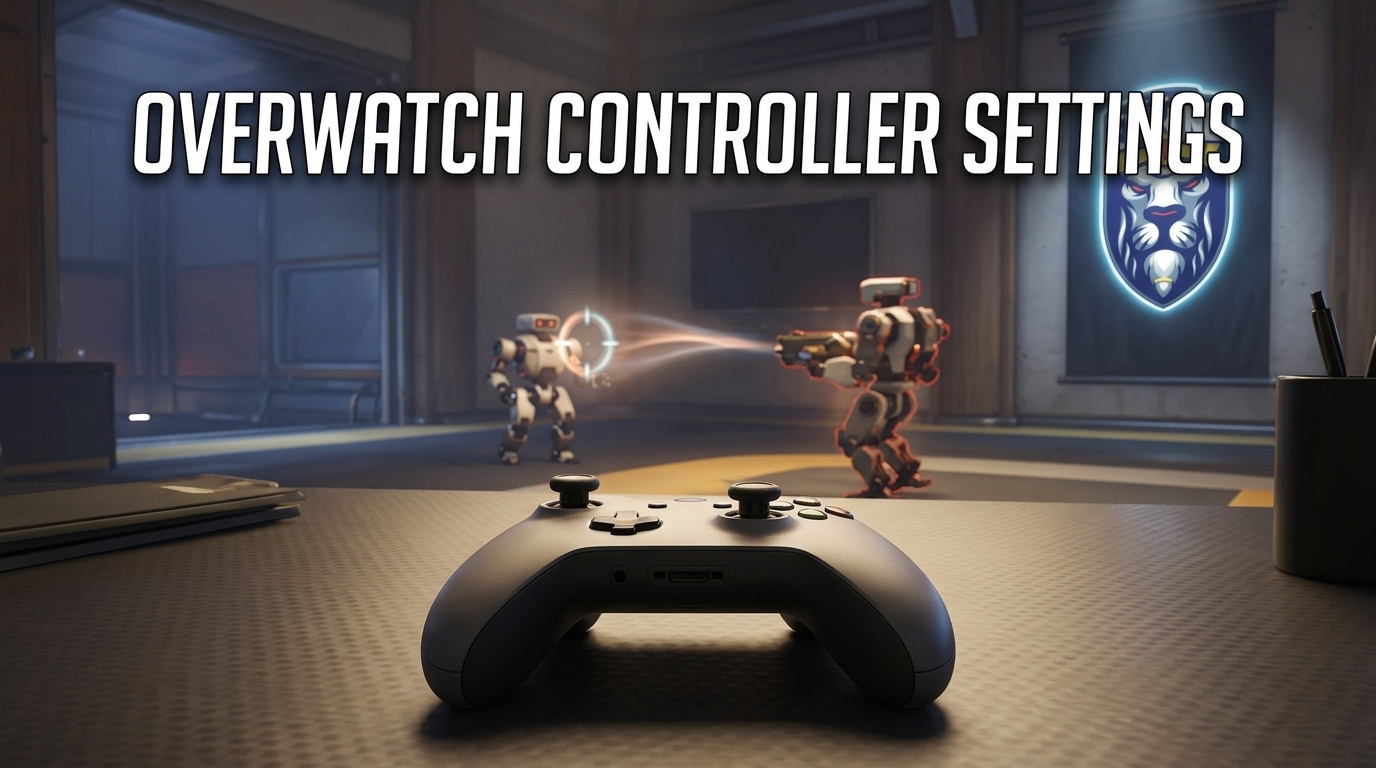
There is no proven universal preset for the best Overwatch controller settings. A practical test baseline is Dot Esports' March 2024 recommendation: 100 Aim Assist Strength, 100 Aim Assist Window Size, and Aim Assist Legacy Mode off. The guide describes a veteran-player trend, not a universal winner; Blizzard later made 60% the Season 20 default for Aim Assist Window Size, so 100 is a recommended test value rather than the current default.
Record your existing settings before trying that profile, then change one control at a time. Use Aim Smoothing to address distance-versus-delay problems, the relevant Ease In category for a hero style, and turning controls for rapid target changes.
No proven universal preset: why 100/100/Legacy-off is only a baseline
Treat the three-setting profile as a clean baseline: save your current setup, try the profile unchanged, and adjust only when you can name the problem you are solving.
Keep the other controls at their existing values for the first comparison. Blizzard explains several controller mechanics but does not endorse a complete numeric preset for horizontal and vertical sensitivity, aim technique, smoothing, vibration, or inner and outer deadzones. It also does not provide a numeric deadzone baseline for stick drift. Without that verification, a longer settings table would add precision without support.
Aim Smoothing is distance versus delay
Aim Smoothing changes how raw stick input reaches your reticle. Blizzard says it smooths that controller input rather than passing every movement through untouched. The result can feel steadier, but "steadier" is not automatically "better." The useful question is whether your current fights reward controlled tracking or immediate response.
Blizzard says Aim Smoothing tends to work better at higher sensitivities and across longer tracking distances. That is the case for testing more smoothing: your crosshair may be easier to hold on a moving target when small stick corrections would otherwise feel twitchy.
The tradeoff hits when somebody jumps into your face. Blizzard also says smoothing can cause delay against closer targets. If your long-range tracking looks clean but your reticle feels stuck in mud during fast close fights, smoothing is the obvious variable to compare. Blizzard does not publish one ideal number here, so anyone crowning a magic value is guessing past the evidence.
Projectile, Hitscan, and Melee controls replaced one-size-fits-all Ease In advice
Season 20 split Aim Assist Ease In into three hero-style controls:
- Projectile for projectile heroes.
- Hitscan for hitscan heroes.
- Melee for melee heroes.
Blizzard says Ease In affects aim-assist strength when the edges of your aim window and an enemy's window first intersect. It also allows separate Ease In tuning on each hero's options page. Use a style control for a problem shared across that category; use the hero override for one pick.
Older guidance moved one general Ease In value toward 100 for hitscan heroes and toward 0 for projectile heroes. That advice came before the three-slider design. It does not establish numeric starting values for the newer Projectile, Hitscan, or Melee controls - or for Disable Aim Assist at Max Deadzone. Check the controls available in your live build and test only the relevant category.
Cassidy, Hazard, and Winston expose slow turning fast
Four additional sensitivity sliders affecting turning speed arrived with Blizzard's Season 20 controller changes. Their job is specific: let the game respond differently when rapid turns and target changes matter. They are not proof that maximum turn speed wins, and Blizzard did not attach one best numeric setup to them.
Blizzard explicitly named Cassidy, Hazard, and Winston as heroes for whom these controls are especially relevant. Cassidy can need sharp target swaps. Hazard and Winston can commit, reposition, and turn on a new threat in the middle of a messy fight. On a controller, a slow turn can feel like fighting the stick while the kill feed turns red.
Use those heroes as the documented test cases. If the failure is getting the reticle onto a new target after a fast turn, compare the turning controls. If the failure happens while holding aim on an existing target, do not assume turn speed is the fix. Different problem. Different slider.
Check the controller before blaming Overwatch
Test the hardware before using software to hide a stick problem. Blizzard's current material does not verify numeric inner or outer deadzone starting values or a deadzone prescription for drift. The steps below come from MyGamepadTester's publisher-reported troubleshooting, not an Overwatch performance test.
- Inspect. Check whether the stick returns to 0,0 at rest without software deadzones.
- Compare. Move it through its full range and look for inconsistent or unreachable input.
- Calibrate. Use only a supported calibration method for your controller.
- Verify. Test again to confirm that the unwanted input changed.
- Repair. Treat persistent erratic readings as a possible physical fault rather than rebuilding every Overwatch setting.
Test your Overwatch controller settings without guessing
Use this comparison loop to turn a vague aiming problem into one clear setting decision. It is a practical testing framework, not a controlled optimization study.
- Record. Save your values or take a screenshot.
- Choose. Name one problem: delayed close tracking, unstable long-range tracking, or slow target switching.
- Change. Adjust only the control tied to that problem.
- Repeat. Keep the hero, target, distance, drill, and duration consistent across both versions.
- Log. Count overshoots, delayed corrections, lost tracking, or failed turns instead of judging one highlight.
- Keep. Use the version that repeatedly gives you more control, then test the next variable.
Start with 100 Aim Assist Strength, 100 Aim Assist Window Size, and Legacy Mode off. From there, let each repeated problem point to the next slider - and keep only changes that help in the situation you tested.
References
What’s next?
Ready to level up your gameplay and climb the ranks in Overwatch 2? Purchase our top-notch Eloking Overwatch 2 Boost now and dominate the competition like never before!
Purchase Overwatch 2 Boost
and start playing at the rank you deserve!
Alternatively, you can Join our Discord Server & participate in various giveaways!
Purchase Overwatch 2 Boost Now













 Quality
