Streamlined three-tier loyalty program where every member enjoys the same high-quality rewards, with benefits escalating at each tier.
Simple yet effective, this program stands as the best deal for Eloking's boosting services, ensuring maximum value and satisfaction for all our users.
Cashback on all Eloking boosts (3%, 5%, 7%)
Discounts for all Eloking boosts (5%, 10%, 15%)
Discount for a friend 🤗
Free daily lootbox spin with industry-leading rewards
Member exclusive season and event offers
VALORANT ban-wave paranoia: when a screenshot turns into a witch hunt
s
Sharik Shaikh
Gamer
10 Jul 2026
Updated On
Listen to this post
TL;DR: VALORANT's ban-wave panic is fueled more by viral screenshots, vague anecdotes, and Riot's past opacity than by solid evidence of widespread false positives. The real takeaway is to verify claims, document your own case, and wait for patterns - because clearer anti-cheat messaging matters more than community-driven witch hunts.
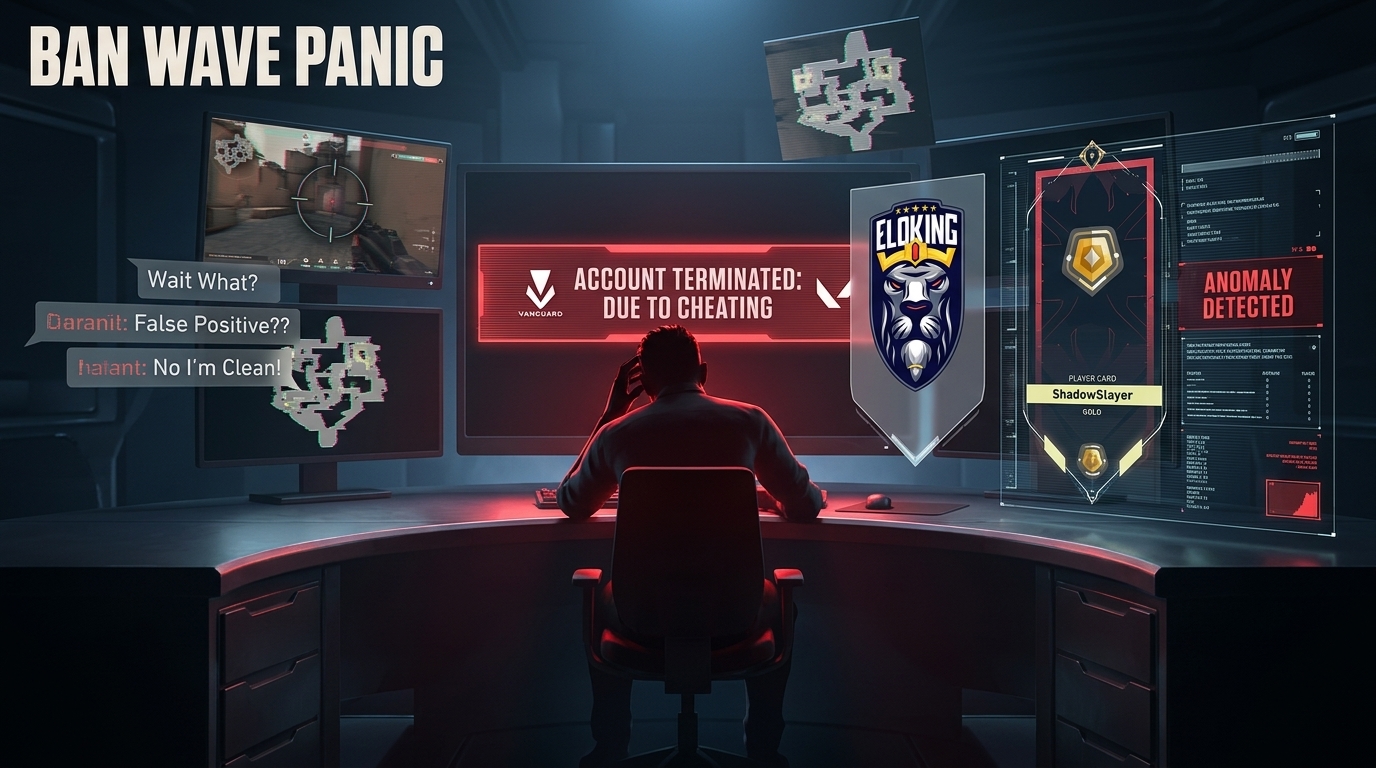
It usually starts with a screenshot: a ban notice, a nickname, a claim that the punishment came out of nowhere. Ban-wave threads like that spread fast through the VALORANT community, and each repost feeds the same fear - that the anti-cheat is swinging blindly and an innocent player could be next. The problem? A ban screenshot arrives with almost no context, so the line between a real enforcement mistake and a story that merely feels true gets dangerously thin.
And when players are already anxious, even Riot's silence can feel like confirmation. So how does a single screenshot turn into false-positive panic, and how do you tell a genuine error from a rumor?
What exactly is driving the VALORANT ban-wave paranoia?
VALORANT ban-wave paranoia is driven less by proof and more by viral screenshots, vague anecdotes, and the way context disappears as claims get reposted. A single ban notice can quickly turn into a community-wide fear that Riot is randomly punishing innocent players, even when the evidence behind the story is thin. The real problem is that a screenshot rarely includes enough context to show whether an enforcement mistake actually happened.
The problem is not just that people see one screenshot and panic. It is that the screenshot arrives with almost no context, then gets treated like a case study. Was the account shared? Was there a cheat flag? Was the ban appeal denied because the player actually broke the rules? Nobody in the repost chain knows, but the story still keeps moving. That is how a single angry post becomes "the system is broken."
Rumor velocity does real damage here. It pushes players to read every enforcement update as proof of a disaster, even when the strongest evidence is still just a handful of loud anecdotes. A bad story spreads faster than a boring explanation ever will. That does not mean false positives never happen. It means the community is often reacting to fear first and evidence second.
Struggling to win? Bad teammates?
Purchase a game with one of our PRO players.
One game
Average wait time <30 minutes
$4.00
$3.32 per game
Two games
Average wait time <30 minutes
$8.00
$3.00 per game
Three games
Average wait time <30 minutes
$12.00
$2.50 per game
Which cases look like real false positives, and which ones are probably just paranoia?
The split that matters is simple: evidence-backed error versus unsupported suspicion. Viral ban claims often do not clear that bar. If a post gives you no direct account details, no timeline, no appeal trail, and no believable trigger, it is not proof of a broken system. It is a story that feels true because it taps into everyone's worst fear.
Decision check
Looks like a real false positive
Looks like paranoia
Account details
Specific account history, clear timing, and a concrete ban outcome are shown.
Vague "my friend got banned" wording with nothing else attached.
Reasoning
The player explains why the ban seems inconsistent with their behavior and can point to an appeal trail.
The post leans on outrage and assumes innocence with no supporting record.
Pattern
Multiple comparable reports, same trigger, same timing, and some kind of repeatable signal.
One loud anecdote treated as if it were common.
Usefulness
The claim helps a reader identify a possible enforcement mistake.
The claim only tells you to panic harder.
That's the line players need to keep in mind. Not "banned or not banned." Not "Riot good or Riot evil." Just: do I have evidence of an error, or do I have a post that knows how to trigger my bias? Those are not the same thing, and the internet loves pretending they are.
Riot's official "Incoming: Vanguard On-Demand" post says Vanguard On-Demand is 100% optional, that Vanguard's driver will no longer start at boot in that mode, and that Vanguard Pre-Check is the security requirement behind it. Riot also says about 35% of players already meet those Pre-Check requirements if their machine is relatively new and in a secured core state.
That matters because naming the system is part of the trust. Players do not just react to bans. They react to mystery. When anti-cheat is a black box, every ban wave feels like a trapdoor opening under the whole community. When Riot gives the system a clearer label and describes what has to be true before it runs, the conversation changes from "what just happened to me?" to "what state is my machine in, and what mode am I actually using?"
This is why the wording lowers rumor fuel even before anyone sees the technical outcome. Better terminology does not magically prove the system is perfect. It does something more useful: it makes the gap between legitimate security checks and random panic bigger. When the story is legible, fewer people need to fill in blanks with the worst possible guess.
That same legibility matters when Riot turns the screws on hardware cheats. The backlash around DMA cheating hardware — the expensive external rigs Vanguard has been turning into scrap — showed how fast the conversation turns when the anti-cheat story sounds bigger than a normal ban wave. Players were already quoting the "$6K paperweight" line, and the whole debate shifted from "who got banned?" to "what hardware is even safe now?" That kind of language is why every update gets treated like a threat first and a policy second. The VAN restriction / ban appeal language only works if players can read it without needing a decoder ring.
What should players actually do when ban-wave rumors start flying?
Pause. Do not repost the first screenshot you see like it is courtroom evidence.
Check. Verify the claim against official Riot messaging before you assume a wave is real.
Document. Save your own account status, timestamps, and any appeal info if you are personally affected.
Verify. Compare the story against whether the claim has actual details or just outrage.
Separate. One player's ban is not automatically a system-wide crisis.
Wait. Let patterns emerge before you turn a rumor into your whole worldview.
That sounds basic because it is. But basic is what keeps you from spiraling. The second a ban rumor starts trending, the whole job is to slow your own brain down long enough to ask one question: do I know anything, or do I just know that people are scared? If you do not know the difference, you are not being informed. You are being farmed by the timeline.
And if you are the one actually hit with a VAN restriction, go straight to the ban appeal path instead of rage-posting into the void. That is not me saying Riot's appeals are always perfect. It is me saying the appeal trail beats the clown show every time.
The real takeaway: trust beats panic, but only if Riot keeps making anti-cheat legible
Why does all of this actually matter? Because anti-cheat works better as a trust system when players can understand what is happening to them. Riot does not win credibility by making people guess harder after a ban lands. It wins credibility by making the process legible enough that a normal player can tell the difference between a real security action and a rumor getting out of hand. The Jun. 24, 2026 Vanguard On-Demand / Vanguard Pre-Check update points in that direction.
The contrarian part is this: Riot does not need perfection to protect its reputation. It needs clarity. Players can live with strict enforcement. They can even live with the occasional mistake if the system is explainable, consistent, and not wrapped in mystery. What they cannot stand is being left to decode every ban through screenshots, panic posts, and half-baked theories. In VALORANT, trust is the real rank diff.
And that is the part the panic crowd keeps missing. Clarity does not excuse Riot from being wrong. It just keeps the whole community from turning every enforcement update into a meltdown before anyone has the facts. That's the line between a healthy anti-cheat conversation and a grief fest of our own making.
How long should a player wait before treating a ban-wave rumor as real?
Wait for repeatable reports, not repost momentum. A rumor becomes worth discussing only when multiple cases show the same trigger, similar timing, and enough detail to verify that the pattern is not just panic echoing itself.
What evidence should be saved if an account gets restricted?
Keep screenshots of the restriction notice, exact timestamps, recent account changes, and any appeal responses. If possible, preserve a short timeline of what happened before the restriction, because missing context makes every support review harder to challenge.
Can shared accounts or borrowed setups make a restriction look like a false positive?
Yes, and that is where a lot of bad claims get sloppy. Shared access, compromised logins, or hardware changes can all muddy the trail, so account history matters as much as the ban message itself.
What should you do if a restriction notice appears after a hardware or security change?
Do not assume the anti-cheat flagged you for cheating just because the timing feels brutal. Review recent BIOS, TPM, secure boot, virtualization, or driver changes first, because security-state shifts can change how the system classifies the machine.
Why do extreme ban numbers spread so fast in gaming communities?
Big numbers feel like proof even when they are just bait. A wild claim gets copied faster than a careful explanation, and by the time people ask for details, the screenshot has already done its damage.
FAQs
Wait for repeatable reports, not repost momentum. A rumor becomes worth discussing only when multiple cases show the same trigger, similar timing, and enough detail to verify that the pattern is not just panic echoing itself.
Keep screenshots of the restriction notice, exact timestamps, recent account changes, and any appeal responses. If possible, preserve a short timeline of what happened before the restriction, because missing context makes every support review harder to challenge.
Yes, and that is where a lot of bad claims get sloppy. Shared access, compromised logins, or hardware changes can all muddy the trail, so account history matters as much as the ban message itself.
Do not assume the anti-cheat flagged you for cheating just because the timing feels brutal. Review recent BIOS, TPM, secure boot, virtualization, or driver changes first, because security-state shifts can change how the system classifies the machine.
Big numbers feel like proof even when they are just bait. A wild claim gets copied faster than a careful explanation, and by the time people ask for details, the screenshot has already done its damage.
What’s next?
Take your Valorant gameplay to the next level and climb the ranks with ease - buy Valorant boost now!
Purchase Valorant Boost
and start playing at the rank you deserve!











 Quality
