Streamlined three-tier loyalty program where every member enjoys the same high-quality rewards, with benefits escalating at each tier.
Simple yet effective, this program stands as the best deal for Eloking's boosting services, ensuring maximum value and satisfaction for all our users.
Cashback on all Eloking boosts (3%, 5%, 7%)
Discounts for all Eloking boosts (5%, 10%, 15%)
Discount for a friend 🤗
Free daily lootbox spin with industry-leading rewards
Member exclusive season and event offers
How Retake Mode Affects Rank Balance in VALORANT
p
Jack Willa
Gamer
12 Jul 2026
Updated On
Listen to this post
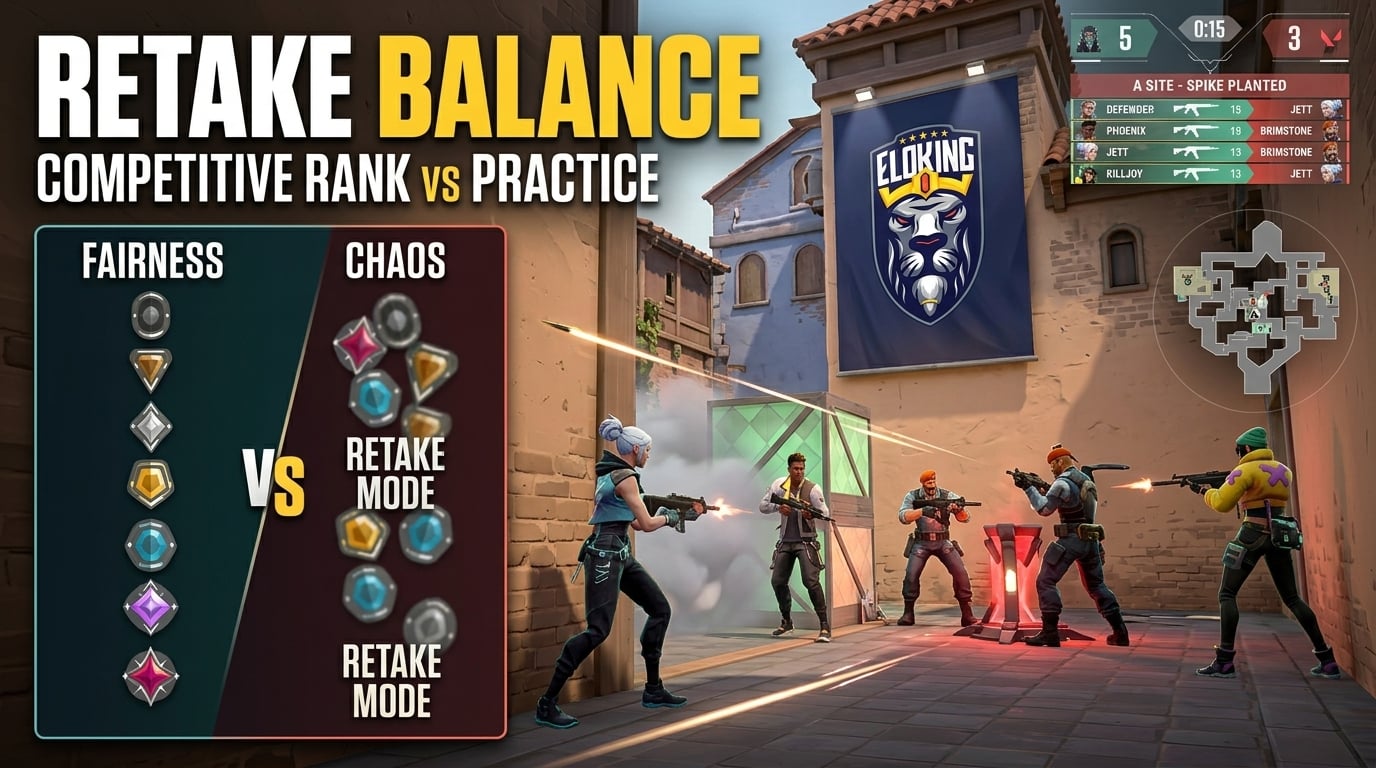
TL;DR: VALORANT's Retake Mode is a limited-time practice mode, not a true ranked test, so its lobbies can feel uneven without meaning the ladder is broken. Patch 13.00 tuned Competitive fairness separately, while Retake mainly rewards timing, utility discipline, and map knowledge rather than pure MMR balance.
One match can feel like a promotion, the next like punishment - and in VALORANT, Retake Mode is quietly deciding who gets the better odds. The mode is supposed to sharpen clutch instincts, but it can also skew the kind of practice players get, which means rank balance may not be as fair as it looks on paper. If one side keeps getting more realistic high-pressure reps than the other, what happens to the ladder when everyone queues back into ranked?
That's the tension hiding inside Retake Mode: a feature meant to improve competition may be tilting it in subtle ways. The real question is whether it helps players climb evenly, or whether it creates an advantage that reshapes rank balance from the inside out.
VALORANT Patch 13.00 adds Retake mode, not a new ranked ladder
The biggest mistake players make is treating Retake like a hidden Competitive playlist. It is not. Patch 13.00 introduced Retake as a limited-time mode alongside Summit, and the point was faster fights, faster reads, and more reps on site execution. If you want balanced rank progression, queue Competitive. If you want repeatable post-plant chaos and retake practice, queue Retake.
That matters because rank balance only means something when the mode is built to measure it. Retake is built to test timing, utility, and trading under pressure. It is not built to hand you a pristine matchmaking spreadsheet.
Struggling to win? Bad teammates?
Purchase a game with one of our PRO players.
One game
Average wait time <30 minutes
$4.00
$3.32 per game
Two games
Average wait time <30 minutes
$8.00
$3.00 per game
Three games
Average wait time <30 minutes
$12.00
$2.50 per game
RR/MMR adjustments tell you what Riot cares about
Riot's 13.00 patch notes specifically say it is adjusting Ranked Rating (RR) calculations to improve consistency in Competitive lobbies. That is the clearest indicator in the patch notes that ranked fairness is being addressed in Competitive, not in Retake. When Riot adjusts ranked, it names ranked; when it introduces a side mode, it describes the side mode on its own terms.
So if your Retake lobby feels lopsided, that is not proof that VALORANT's entire skill system is broken. It is proof that a side mode can still feel messy even while the main ranked ladder is being tuned separately.
Your move: use Retake as a warm-up for ranked habits. If you lose one-sided rounds, look at the replay in your head and ask one question: did we trade, or did we all dry peek like animals?
Summit map changes how balance feels more than your badge does
Summit changes the rhythm of the mode, and rhythm matters more than badge matching in Retake. A new map always exposes the same thing first: who understands timing and who is just winging it. On a fresh map, even players with similar ranks can feel wildly uneven because the real diff is map knowledge, not MMR.
That is why early Retake balance complaints are often really Summit complaints. People call it unfair when they actually mean unfamiliar.
What to do: load Summit in a custom and walk every choke, plant lane, and retake entry. If you cannot name the first safe swing and the first dangerous angle, you are not judging balance yet. You are just getting farmed by information.
Gekko reclaim cooldown 15s and the 50s initiator cooldowns matter in Retake
Patch 13.00 also hit utility pacing. Gekko reclaim cooldown at 15 seconds and Sova, Fade, Skye, Breach, and KAY/O cooldowns at 50 seconds change how long a retake sequence can keep going before someone runs dry. That matters a lot in Retake, where one extra scan, flash, or stun often decides the round.
In practice, this makes balance feel better for coordinated stacks and worse for solo players who waste utility early. If your team burns every piece of info in the first five seconds, the round snowballs. If you hold one piece for the final retake hit, the mode suddenly feels fair.
Action step: before you queue, pick one utility rule. For example, on initiator, do not throw your first drone/recon/flash until your team is actually ready to move. If you burn it just to feel active, you are griefing your own retake.
The honest answer: Retake balance is about practice, not purity
If you want the blunt answer, here it is: Riot has not detailed how Retake matchmaking works, so any claim about how "rank-balanced" its lobbies are is guesswork. What is confirmed is that the mode is there to sharpen habits, not to serve as a replacement for Competitive rank testing. In that sense, it is better viewed as a limited-time practice mode than as a purity test for skill.
That is why the smartest players stop arguing about whether Retake is fair enough and start asking whether it makes them better. If the answer is yes, keep queuing while the mode is available. If the answer is no, you are probably wasting time chasing a balance fantasy the mode was never built to deliver.
Retake is for reps. Competitive is for rank. Mix those up and you will stay mad forever.
Does Retake Mode use your Competitive rank to build lobbies?
Riot has not detailed how Retake matchmaking builds its lobbies. What is confirmed is that Retake has no RR stakes, so your Competitive rank is not on the line in the mode - it is built for repeat practice rather than ladder testing.
Why does Retake feel so much more chaotic on a new map?
Because map knowledge beats badge similarity when nobody knows the timings yet. On a fresh map, the player who knows the first safe swing, the first dangerous angle, and the fastest plant lane gets a free edge that looks like imbalance but is really information.
What kind of mistakes get punished hardest in Retake?
Dry peeking, burning utility too early, and failing to trade. Retake is designed to punish impatience, so a team that uses one flash or scan at the wrong moment can lose the round before the retake even starts.
Should I use Retake as part of a ranked warm-up?
Yes, if you treat it like a timing drill instead of a score check. It is useful for rehearsing post-plant spacing, trading, and utility timing before Competitive, where those habits actually decide RR gains and losses.
FAQs
Riot has not detailed how Retake matchmaking builds its lobbies. What is confirmed is that Retake has no RR stakes, so your Competitive rank is not on the line in the mode - it is built for repeat practice rather than ladder testing.
Because map knowledge beats badge similarity when nobody knows the timings yet. On a fresh map, the player who knows the first safe swing, the first dangerous angle, and the fastest plant lane gets a free edge that looks like imbalance but is really information.
Dry peeking, burning utility too early, and failing to trade. Retake is designed to punish impatience, so a team that uses one flash or scan at the wrong moment can lose the round before the retake even starts.
Yes, if you treat it like a timing drill instead of a score check. It is useful for rehearsing post-plant spacing, trading, and utility timing before Competitive, where those habits actually decide RR gains and losses.
What’s next?
Take your Valorant gameplay to the next level and climb the ranks with ease - buy Valorant boost now!
Purchase Valorant Boost
and start playing at the rank you deserve!















 Quality
