Streamlined three-tier loyalty program where every member enjoys the same high-quality rewards, with benefits escalating at each tier.
Simple yet effective, this program stands as the best deal for Eloking's boosting services, ensuring maximum value and satisfaction for all our users.
Cashback on all Eloking boosts (3%, 5%, 7%)
Discounts for all Eloking boosts (5%, 10%, 15%)
Discount for a friend 🤗
Free daily lootbox spin with industry-leading rewards
Member exclusive season and event offers
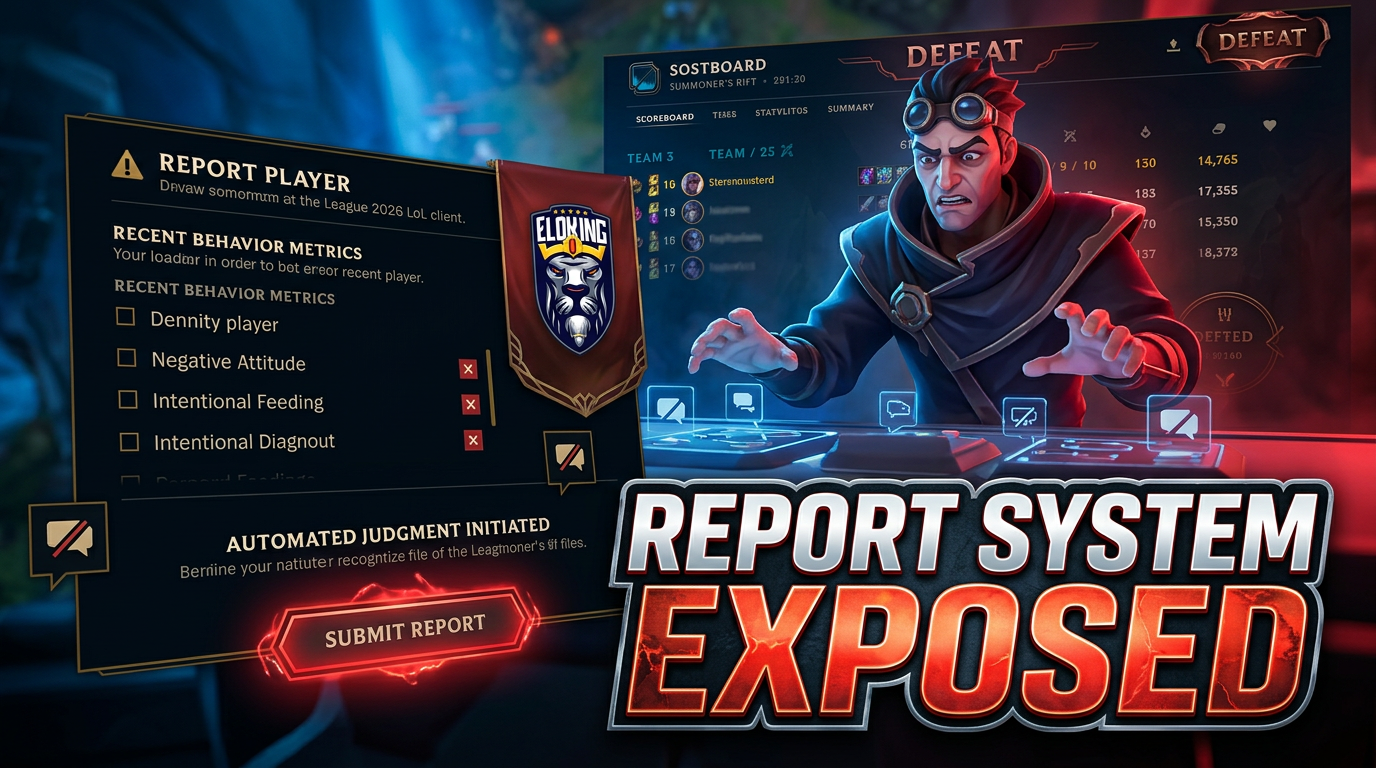
How Riot's Report System in League of Legends Works in 2026
h
Hamza Rashid
Gamer
02 Jul 2026
Updated On
Listen to this post
TL;DR: Riot's report system in League of Legends is mostly automated, slow, and opaque, so one bad match can still lead to punishment while many reports seem to vanish into silence. The core issue isn't that it never works, but that players rarely get clear, timely feedback proving it did.
A player gets banned after a single match - and the part that should be obvious, the thing they said in chat, isn't even the whole reason. In League of Legends, Riot's report system doesn't just collect complaints; it quietly funnels them through filters, penalties, and automated decisions that can turn one ugly game into a permanent consequence. So what actually happens after you click Report, and how does Riot decide who gets punished, who gets ignored, and who slips through?
The answer is more complicated than most players think, and in 2026 the system has become even harder to predict. Here's how it works.
Patch 26.13 showed Riot can still walk back a bad call
If you want to understand the current report-system argument, start with the June 24, 2026 Riot reversal on Last Hit Indicators in Ranked. Riot was "pretty confident" the tool wouldn't degrade skill expression, but they changed course after community backlash. This matters because it teaches the player base one thing: pressure works. When Riot moves on a visible gameplay system, players start asking why behavior systems should get a free pass.
The move also feeds a nasty assumption: if Riot can change a ranked-feeling system after enough noise, then maybe the report pipeline only moves when the community screams loud enough. That is not proof the system is broken; it is proof trust is thin. The whole episode sits in that same bucket of live-service friction where players watch Riot tweak the game, then wonder why griefers seem to skate by anyway.
If your last three reports felt useless, one clean patch note is not going to save Riot's reputation. Players are looking for the same responsiveness in toxicity enforcement that they see in gameplay balance, but the automated nature of the report pipeline makes that level of transparency difficult to achieve.
Struggling to win? Bad teammates?
Purchase a game with one of our PRO players.
One game
Average wait time <30 minutes
$4.00
$3.32 per game
Two games
Average wait time <30 minutes
$8.00
$3.00 per game
Three games
Average wait time <30 minutes
$12.00
$2.50 per game
The April 2021 behavioral update didn't settle anything
Riot's April 2021 Behavioral Systems update is the reference point people usually reach for here, but it never settled the harder problem: the system struggles to catch "soft inting" - sophisticated griefing that stays just below the automated detection threshold. While Riot claims their tech is "continually improving," strategic trolls often slip through while average players feel the weight of the algorithm.
That gap is what makes the silence so corrosive. If the system is slow and opaque, it doesn't matter how many updates Riot ships. The system can work perfectly on paper and still feel like a failure to the person trapped in a lobby with a repeat offender.
What players should actually do after a griefed game
Do not spam reports like you're mashing Q into a Yasuo wind wall. Use the report screen once, pick the category that best matches what happened, and add a short note only if it helps identify the behavior. If someone intentionally ran it down, type exactly what happened: "Intentional feeding mid," "AFK after 8:00," or "Soft inting side lane." Keep it specific. Vague reports are noise.
Reporting priorities can shift depending on your queue. In Summoner's Rift Ranked, the system is tuned for high-stakes competitive integrity, while in Co-op vs. AI or Swiftplay, detection is meant to distinguish genuine griefing from newer players still learning mechanics. Whatever the queue, the goal is a clean report: do not argue in all-chat or chase the troll into postgame. A long flame war only risks getting your own account flagged by the automated filter.
If you need a reset after a bad streak, lock in a role where you can focus on your own play instead of trying to play courtroom prosecutor. In a community this frustrated, the less emotional baggage you feed the system, the cleaner your reports are when they actually count. Riot's pipeline is slow enough; do not hand it reasons to ignore you.
Riot needs clearer feedback, not another silence wall
Here's the real fix: Riot should tell players more than "action was taken." Give a stronger confirmation loop. Say whether the penalty was a chat restriction, ranked restriction, or account action. Let the reporter know whether the case was for griefing, AFK behavior, or verbal abuse without exposing the offender. Players do not need a dossier. They need proof the report did something.
Riot should also shorten the gap between report and response where possible, especially for repeat offenders. If someone gets punished three days later, that still beats silence. If someone gets hit fast after a pattern of reports, even better. The system does not have to be flashy. It has to feel real.
That is why this whole debate keeps coming back. People are not asking Riot to become perfect. They are asking Riot to stop acting like invisible punishment is enough. In a game this tilted, if you want players to believe the system works, you have to show your work.
Can a report still matter if the player only ruined one game and then stopped?
Yes. A single match can still trigger a penalty if the behavior is severe enough or matches a pattern the system already recognizes. The catch is that the punishment may come later, with no visible link to the report that helped trigger it.
What should you include in a report if chat abuse was only part of the problem?
Name the behavior, not the mood. Phrases like “intentional feeding mid,†“AFK after 8:00,†or “soft inting side lane†give the system a cleaner signal than generic anger. If the player also spammed chat, report that separately in the same submission only if it genuinely happened.
Do reports from different queue types get treated the same way?
Not always. Ranked reports are weighted around competitive integrity, and automated detection is designed to distinguish real griefing from inexperienced play. That means the same behavior can get interpreted differently depending on the queue and the surrounding game context.
Why do some punished players seem to keep playing for days before anything happens?
Because enforcement is not always immediate. A report can sit behind filters, pattern checks, and automated review before any action lands, so the delay does not mean nothing happened. It usually means the system wanted more than one angry click before it moved.
Can arguing with a troll in chat backfire on your own account?
Absolutely. Long flame chains and postgame harassment can get caught by automated moderation even if you were the one being targeted. The cleanest move is to report once, mute, and leave the lobby with your account untouched.
FAQs
Yes. A single match can still trigger a penalty if the behavior is severe enough or matches a pattern the system already recognizes. The catch is that the punishment may come later, with no visible link to the report that helped trigger it.
Name the behavior, not the mood. Phrases like “intentional feeding mid,” “AFK after 8:00,” or “soft inting side lane” give the system a cleaner signal than generic anger. If the player also spammed chat, report that separately in the same submission only if it genuinely happened.
Not always. Ranked reports are weighted around competitive integrity, and automated detection is designed to distinguish real griefing from inexperienced play. That means the same behavior can get interpreted differently depending on the queue and the surrounding game context.
Because enforcement is not always immediate. A report can sit behind filters, pattern checks, and automated review before any action lands, so the delay does not mean nothing happened. It usually means the system wanted more than one angry click before it moved.
Absolutely. Long flame chains and postgame harassment can get caught by automated moderation even if you were the one being targeted. The cleanest move is to report once, mute, and leave the lobby with your account untouched.















 Quality
