Streamlined three-tier loyalty program where every member enjoys the same high-quality rewards, with benefits escalating at each tier.
Simple yet effective, this program stands as the best deal for Eloking's boosting services, ensuring maximum value and satisfaction for all our users.
Cashback on all Eloking boosts (3%, 5%, 7%)
Discounts for all Eloking boosts (5%, 10%, 15%)
Discount for a friend 🤗
Free daily lootbox spin with industry-leading rewards
Member exclusive season and event offers
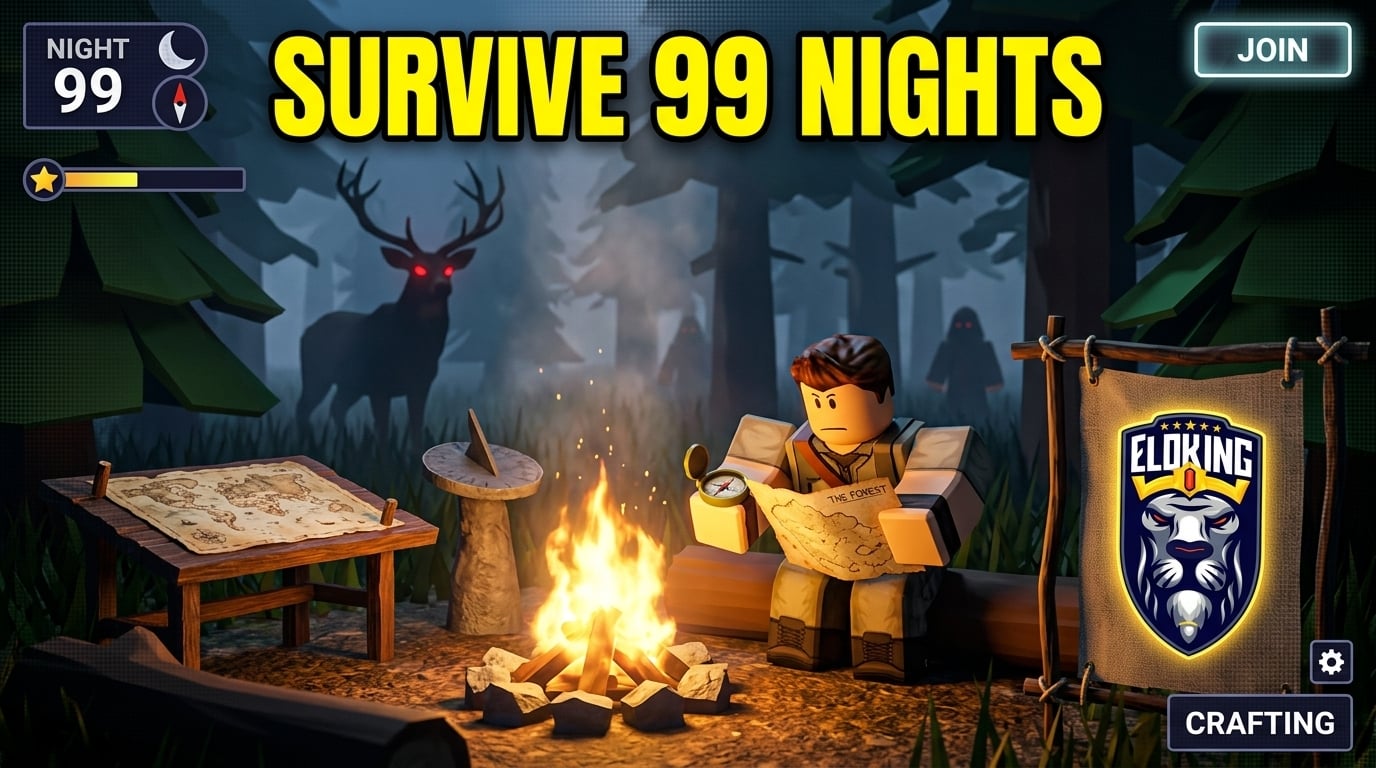
How to Survive 99 Nights in the Forest with the Compass
j
Anthony King
Gamer
02 Jul 2026
Updated On
Listen to this post
TL;DR: Survival in 99 Nights in the Forest comes from building a strong, efficient camp and managing time, not fighting every threat. Prioritize nearby resources, early fire upgrades, navigation tools, and returning before dark; the players who last longest play clean, planned routes and avoid greedy, unnecessary fights.
Ninety-nine nights. One forest. And in Roblox, the things hunting you don't wait until you're ready.
If you burn through your supplies too early, get lost after dark, or miss the signs that danger is closing in, the run ends fast - and the forest gets worse every night. So how do you stay alive long enough to see night 99?
What is the real beginner mistake in 99 Nights in the Forest?
Beginners usually lose because they keep trying to win every early scrap instead of building a camp that does the work for them. That's the whole trap. The game looks like a monster chase, so new players act like every night is about clutching a fight. It is not. It is about turning your base into a machine that makes night one, night two, and night three less messy than the last. BloxGuidesGG's 2026 beginner guide and Pro Game Guides both push the same idea in different ways: the players who survive are the ones who stop improvising and start building a safer loop around camp.
The early game is brutal because the forest keeps taxing bad decisions. If you wander too far for one extra pile of wood, you are the one paying for the trip when the sky starts dimming. If you stay out trying to "clear" threats like this is a brawler, you burn time, lose position, and come back late. That is how runs die. Not with one huge mistake. With five small ones. One bad route. One greedy fight. One night where your fire is too weak. A survival game with escalating pressure does not reward ego. It rewards systems.
The better mental model is simple: expand your safety first, then move farther out once the camp can support it. Everything else hangs off that. Better fire. Better access. Better timing. Less panic. Once you see the game that way, the first nights stop feeling random and start feeling readable.
What should you do on Day 1 to set up survival?
Secure the camp area first and stop thinking about long trips. Put your first effort into the space around spawn so you are not building while already exposed.
Gather the closest wood and basic scrap before you chase anything deeper in the forest. The goal is to get the camp functioning fast, not to prove you can roam.
Upgrade the fire as early as possible, because a stronger campfire gives you more breathing room and makes the safe zone less tiny and stressful.
Loot nearby structures only if they are on the way. If a building is making you walk half the map, it is not a shortcut. It is a delay.
Craft early utility as soon as the bench allows it instead of hoarding materials for some "perfect" purchase later. Early power beats imaginary value.
Return before the light dies. If you are still deep in the woods when dusk hits, you already played the day badly.
Why are Map craft, Compass, and Sundial so valuable early?
Map craft, Compass, and Sundial are not convenience items. They are anti-tilt tools. Most beginners do not die because the forest is impossible; they die because they get lost, waste too much daylight, or misjudge how much time they actually have left before night becomes a problem.
The Map is the obvious one. It helps you stop wandering around like you have no route in mind. If you know where you are and where you are trying to go, every trip gets cleaner. The Compass is the next layer. It keeps you from turning a simple resource run into a loop of bad direction changes and backtracking. That sounds small until you realize how many runs die because a player thought they were "almost home" and were actually just deeper in the woods. The Sundial does a different job: it tells you when not to be greedy. Time management is a survival stat in this game. If you are using daylight badly, the forest punishes you at night.
These tools work because they save the only thing beginners waste the most: time. Not just movement time. Decision time. They help you get back to the real plan faster, which is still the same one every strong run follows. Expand the camp. Shorten the risky trips. Stop playing lost in the dark.
How should beginners handle the first major threats?
How do you survive The Deer on the first night? Do not try to "outplay" it. Stay close to safe ground, keep your light and camp setup ready, and avoid giving it a free catch outside the base. The Deer is not a monster you solve by swinging harder. It is a threat you respect by staying where your setup can protect you.
Why does the Day 2 Pelt Trader matter? Because Day 2 is a checkpoint, not a random spike. By that point, the game is asking whether you used Night 1 to build momentum or just wandered around. A prepared player reaches the trader with enough resources and enough camp progress to make the visit useful. An unprepared player reaches Day 2 still scrambling and misses the whole point. The same logic applies to Day 4 Cultist attacks. That is not the game being unfair. That's the game checking your homework. If your base is still flimsy and your routes are sloppy, Cultists expose it fast.
What should you learn from those early events? That the game is scripted around pressure windows. The Deer, the trader, and the Cultist attacks are not there to surprise you. They are there to measure whether you prepared. Once you stop treating them like chaotic jumpscares, you start building for them on purpose.
What habits separate surviving players from constantly restarting?
Keep the camp growing. The strongest runs never stay static for long, because a bigger and safer base buys you better options on every later night.
Spend daylight with a job. Every trip should have a reason, or you are just donating time to the forest.
Use utility before panic. Map craft, Compass, and Sundial help you avoid the exact mistakes that turn a normal day into a wipe.
Skip pointless fights. If the encounter does not improve your position, it is often just a bad trade waiting to happen.
Return before dark gets mean. The players who live longest are the ones who respect the clock instead of pretending they have one more minute.
Rebuild after every success. A good run is not one clean fight. It is a camp that gets harder to crack after every night.
What should you do next if you keep getting stuck?
Say you lose again because you were halfway across the map when the night pressure kicked in. That is not a combat problem. That is a planning problem. The fix is boring, which is exactly why it works: come back earlier, tighten the base, and make your route shorter before you try to get fancy. The core habit stays the same: improve one survival habit at a time instead of trying to brute-force every run.
So on your next attempt, pick one missing piece and lock it in. Better fire. Cleaner route. Earlier return. One utility tool crafted on time. That is how you stop repeating the same death. Not by playing louder. By playing cleaner.
If you want the blunt truth, the forest is not beating you. Your priorities are. Fix those, and the next run looks a lot less cursed.
How many players should focus on the camp versus roaming early on in a team run?
Early teamwork should split cleanly: one or two players can gather the nearest materials while everyone else keeps the camp from falling behind. A full team wandering off together is how runs rot in real time, because nobody is left to finish the fire, craft utility, or secure the return route before dark.
What if you miss the first chance to upgrade the fire?
Treat the next daylight cycle like damage control, not a fresh start. Pull every nearby resource into the camp path, craft the upgrade at the first possible moment, and stop taking detours that make the safe zone stay tiny for another night.
Do extra fights ever pay off early, or are they mostly a trap?
Most early fights are a bad trade unless they directly open a safer route or protect the camp. If the win does not improve your position, you just spent health, time, and daylight to prove a point the forest does not care about.
What should you do if you get turned around after the sun starts dropping?
Stop pushing deeper and cut the route immediately. The correct move is to use your navigation tools to re-center, then head back while you still have enough visibility to avoid turning one lost minute into a night-side collapse.
Is it worth stockpiling materials for later instead of crafting early utility?
No. Early utility changes how many safe trips you can make, and safe trips are the whole economy of a strong run. Hoarding for a bigger future payoff just leaves you weaker during the nights that decide whether you ever reach that future.
What is the best recovery plan after a failed night?
Rebuild one weak link only: tighter route, earlier return, better fire, or faster navigation. Trying to fix everything at once creates another messy day, and messy days are the reason the next night hurts even more.
FAQs
Early teamwork should split cleanly: one or two players can gather the nearest materials while everyone else keeps the camp from falling behind. A full team wandering off together is how runs rot in real time, because nobody is left to finish the fire, craft utility, or secure the return route before dark.
Treat the next daylight cycle like damage control, not a fresh start. Pull every nearby resource into the camp path, craft the upgrade at the first possible moment, and stop taking detours that make the safe zone stay tiny for another night.
Most early fights are a bad trade unless they directly open a safer route or protect the camp. If the win does not improve your position, you just spent health, time, and daylight to prove a point the forest does not care about.
Stop pushing deeper and cut the route immediately. The correct move is to use your navigation tools to re-center, then head back while you still have enough visibility to avoid turning one lost minute into a night-side collapse.
No. Early utility changes how many safe trips you can make, and safe trips are the whole economy of a strong run. Hoarding for a bigger future payoff just leaves you weaker during the nights that decide whether you ever reach that future.
Rebuild one weak link only: tighter route, earlier return, better fire, or faster navigation. Trying to fix everything at once creates another messy day, and messy days are the reason the next night hurts even more.
What’s next?
Now that you have learned something new - it’s time you start playing and get better. Choose a game to purchase Eloking Boost for.
Purchase ELO Boost at Eloking
and start playing at the rank you deserve!












 Quality

